Introduction: XGC Mind Set
Carbon credits, when properly structured, are one of the most powerful financial tools we have to restore ecosystems and reward those who care for them. At XGC, we don’t see carbon markets as abstract trading platforms — we see them as mechanisms for justice, for regeneration, and for long-term prosperity. The real value of a carbon credit isn’t just in the ton of CO₂ it offsets — it’s in the mangrove it helps replant, the coastline it protects, the fish nursery it revives, and the family it feeds.
What makes XGC’s platform different is that we’ve engineered it to trace impact — not just emissions. Our registry and ERP systems ensure that funds from international buyers don’t disappear into bureaucratic black boxes. They flow — with complete transparency — from buyers to national governments, to accredited projects, to the very communities planting the trees, restoring the seagrass, and protecting the biodiversity that underpins our food systems. We’ve built the infrastructure that lets money move at the speed of trust.
This isn’t just climate finance. It’s environmental sovereignty. It’s making sure a woman restoring a mangrove forest in Ghana gets paid directly, in full, without delay. It’s creating incentives that align global carbon goals with local livelihoods — not in theory, but in practice, every day. That’s what XGC was built to deliver.
XGC at the Market Crossroads
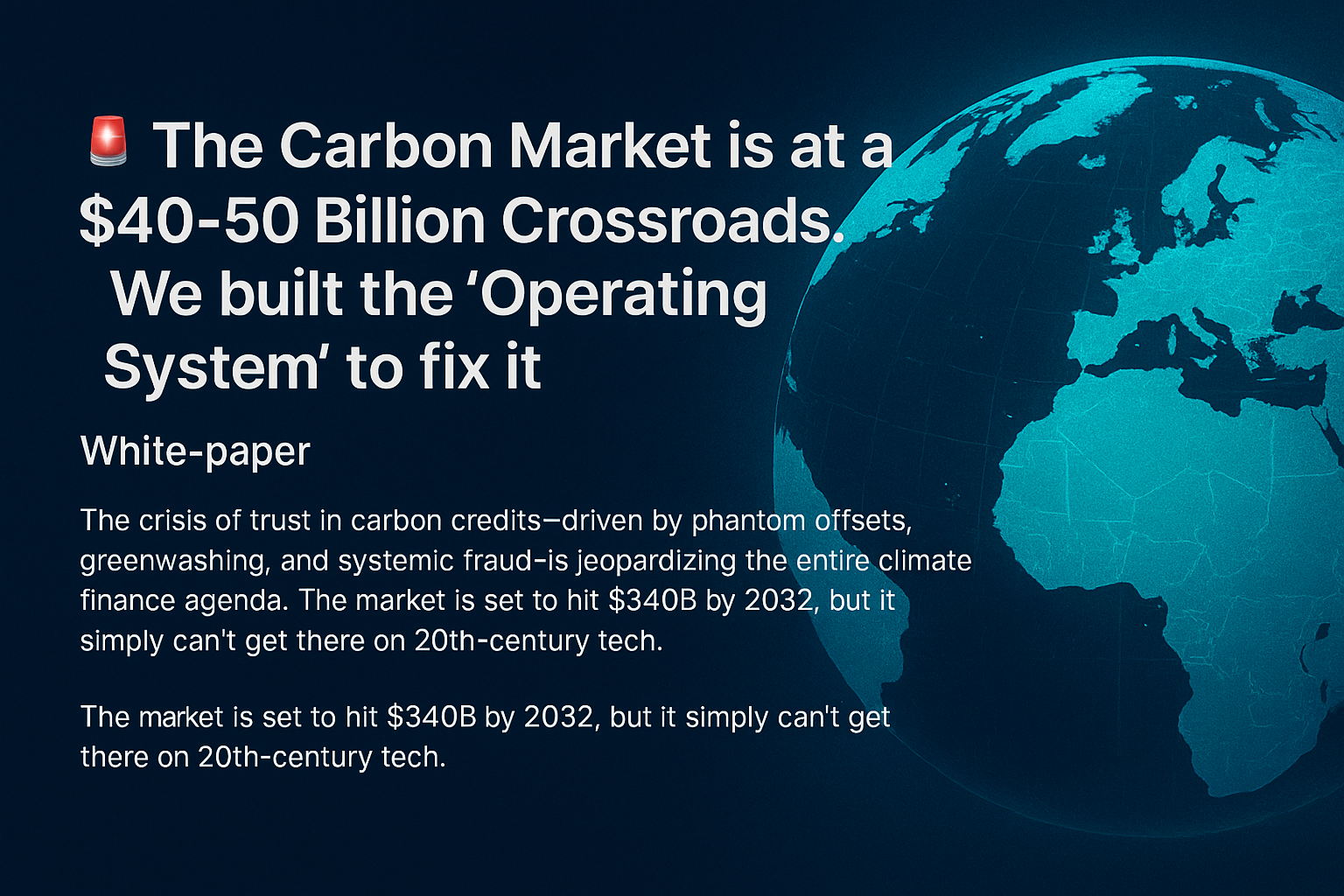
The global market for carbon credits is undergoing a transformative, explosive growth phase, rapidly ascending from a niche concept to a multi-billion-dollar pillar of global climate strategy. Market analysts are unified in their projections, forecasting that the carbon credit market will surge to a staggering $340 billion by 2032, maintaining a robust annual growth rate of approximately 15%. This immense expansion is not accidental; it is driven by two critical, interconnected forces: the urgent, collective global commitment to deep decarbonization, and the foundational role of market-based mechanisms, particularly carbon trading, enshrined in the Paris Agreement.
Yet, this monumental promise of climate finance has been critically undermined by a profound, decade-long crisis of confidence and integrity. The voluntary and compliance carbon markets, essential tools for cost-effective emissions reduction, have been riddled with systemic issues. Over the past decade, a conservative estimate suggests that widespread fraud, sophisticated greenwashing schemes, and outright tax scams have collectively drained an estimated $40–50 billion from these vital markets. Trust in the fundamental value and reality of carbon credits has consequently collapsed.
Headlines have repeatedly exposed a litany of failures:
- Phantom Offset Projects: Credits issued for emissions reductions that never actually occurred.
- Bogus Corporate Claims: Companies relying on invalid or expired credits to claim “net-zero” status that they had not earned.
- Organized Crime Infiltration: The use of opaque market structures by criminal elements to launder money and profit from fraudulent credit generation.
These disclosures have forced governments, international regulatory bodies, and climate-focused investors to confront a stark, fundamental question: Can the current system of carbon finance be reliably fair, transparent, and capable of generating real, verifiable climate action?
From the perspective of those who have dedicated years to the frontlines of climate technology and finance, the answer is clear: Today’s carbon markets stand at a critical and undeniable crossroads. On one side, the political will for market-based solutions remains strong. The data is compelling: 83% of all Nationally Determined Contributions (NDCs)—countries' climate pledges under the Paris Agreement—explicitly plan to use international carbon credit trading as a key mechanism to achieve their emissions-reduction targets cost-effectively. This demonstrates a global consensus that high-integrity carbon markets are an indispensable tool, not an optional luxury.
On the other side, the prevailing market infrastructure has proven itself fundamentally unfit to safeguard this integrity. The current operational environment is often characterized by a decentralized, ad hoc system reliant on unverified spreadsheets, self-reported data from credit generators, and a blind, usually naive, reliance on trust. It is an unsustainable model. It is impossible to run a future trillion-dollar climate finance market on infrastructure designed for small-scale accounting. The world requires a radical, structural overhaul.
This white paper proposes a new approach: XGC’s National Carbon Registry Solution. This is not a partial patch but a complete, ERP-grade “operating system” for national carbon market management. It is designed to restore trust and unlock the full, legitimate potential of carbon credits by integrating three core technological pillars:
- Artificial Intelligence (AI): For autonomous, real-time validation of project data, emissions modeling, and anomaly detection to flag fraudulent activity before credits are issued.
- Blockchain Tokenization: To provide an immutable, transparent, and auditable record of every single credit from its creation (minting) to its eventual retirement (burning), eliminating double-counting and ensuring clear ownership.
- ERP-Grade Compliance & Governance: Implementing enterprise-level security, role-based access, and internationally compliant accounting standards to ensure the registry operates with the same rigor as national financial infrastructure.
We will first conduct a forensic examination of the structural roots of the integrity crisis, detailing precisely how the current system failed. We will then demonstrate, with concrete examples, how XGC’s solution permanently fixes these vulnerabilities, highlighting early traction and real-world deployment in key regions, particularly across Africa and other emerging markets, where the need for trustworthy climate finance is most urgent. All claims presented herein are meticulously validated with authoritative, third-party sources and aligned with international consensus to ground this vision in irrefutable data and global standards.
The Lost Decade of Carbon Market Failures (2014–2024)
Carbon Credit Fraud and Phantom Credits
In unregulated voluntary markets, brokers peddled millions of non-existent or inflated carbon offsets. One UK carbon credit firm scammed investors out of £36 million through worthless certificates. In the U.S., a recent joint CFTC and DOJ investigation uncovered a project developer (CQC Impact LLC) that fraudulently obtained “millions more” carbon offset credits than warranted by using falsified data. These phantom credits flooded the market, undermining legitimate projects. Independent analysis in 2023 confirmed how pervasive the problem was: more than 90% of rainforest carbon offsets from the world’s leading certifier were essentially “phantom credits,” providing no real emissions benefit. In other words, the very credits companies relied on to offset emissions were often hot air. The impact was devastating – buyers lost confidence, prices plummeted, and bona fide climate projects struggled to compete.
Root cause: Project developers and offset vendors operated on an honor system. They self-reported baselines and results with little oversight. Verification was paper-based and periodic, making it easy to game. There was no independent, real-time monitoring or central authority to catch discrepancies. In short, carbon credits lacked an immutable, automated source of truth.
Corporate Greenwashing and ESG Scandals
At the same time, corporate climate claims faced a reckoning. More than 1,000 companies have been investigated for misleading “carbon neutral” or ESG statements in recent years. High-profile cases abounded: Volkswagen’s “Dieselgate” scandal – where the automaker cheated emissions tests – ultimately cost the company €31.3 billion (~$34.7B) in fines and settlements. In the U.S., Toyota was fined $180 million for systematically failing to report vehicle emissions defects. Major financial institutions were caught exaggerating the sustainability of their funds; for example, Deutsche Bank’s asset manager, DWS, paid €25 million for “greenwashing” violations after a probe found that its ESG claims did not match reality. Overall, corporate greenwash penalties easily exceeded $35 billion in this decade, not counting the unquantifiable reputational damage. Public trust in corporate climate pledges eroded as people realized many “net zero” promises were built on creative accounting or outright deceit.
Root cause: Companies can make climate claims without data to back them up. Sustainability reports were often glossy PDFs with selective metrics. Underlying emissions data were siloed or based on manual self-reporting, with no real-time government or third-party audits. This lack of an integrated compliance system meant even well-intentioned firms sometimes overstated progress, while bad actors could outright lie until caught years later. In short, there was no “single source of carbon truth” for regulators, investors, and the public to verify corporate claims in real time.
Carbon Market Tax Fraud (VAT Carousel Schemes)
Even compliance carbon markets fell victim to large-scale fraud. In the EU’s Emissions Trading System (ETS), criminals exploited cross-border VAT rules to conduct “carousel” fraud in carbon allowance trading. Between 2008 and 2009, as much as €5 billion in tax revenue was stolen via carbon VAT scams, and in some countries, up to 90% of all trading volume in the EU carbon market was fraudulent activity. Banks and traders unwittingly (and in some cases knowingly) facilitated these phantom trades before Europol and national authorities cracked down. The EU ETS fraud not only robbed taxpayers but, for a time, undermined the viability of the entire market. Carbon prices whipsawed amid the influx of fake trades, and legitimate participants suffered volatility and a reputational hit.
Root cause: The ETS registries and trading platforms lacked the safeguards of modern financial systems. Serial numbers for carbon allowances were just entries in national databases, not linked to any tamper-proof ledger. There was poor cross-border reconciliation – a credit could be bought VAT-free in one country and resold with VAT in another, with governments none the wiser until after the fact. Simply put, registries were not interoperable or auditable enough. No mechanism existed to flag the rapid round-trip trades characteristic of carousel fraud automatically. This opacity allowed criminals to abuse the system a continental scale.
Emissions Misreporting in Cap-and-Trade Programs
Beyond offsets and credits, even measured emissions under cap-and-trade schemes were found to be cheated. Volkswagen’s Dieselgate was one example in transportation. In the industry and power sectors, multiple cases emerged of factories under-reporting their smokestack emissions or using defective monitoring equipment to circumvent caps. These abuses led to enforcement actions in California and across India. In one instance, a large thermal power plant was found to be manipulating pollution controls and undercounting CO₂ output, breaching its permit. The net effect of such misreporting is higher actual emissions and unfair advantage over compliant facilities. It also creates public health costs (through unreported local air pollution) and damages the credibility of emissions trading regimes.
Root cause: Much like the other failures, these incidents stemmed from fragmented, manual oversight. Emissions data often relied on company-installed sensors or on self-submitted reports to regulators, submitted quarterly or annually. There were minimal real-time alerts for anomalies, and data systems were not integrated – the environmental regulators’ databases didn’t talk to, say, revenue or energy regulators’ systems. Lacking automated cross-checks or AI analysis, it was easy for polluters to hide behind paperwork. Compliance authorities were often playing catch-up with audits long after the fact.
The Systemic Problem: Trust by Trial and Error
Looking across these failures – phantom credits, corporate greenwashing, tax fraud, and misreported emissions – a clear pattern emerges. Carbon markets were built on trust instead of technology. Markets assumed participants would do the right thing, or that occasional human audits would deter the worst abuses. That assumption proved false. Self-reported project data, unverifiable corporate claims, opaque registries, and siloed systems made fraud inevitable. In essence, the world tried to tackle a 21st-century, data-intensive challenge (global emissions trading) with 20th-century tools (spreadsheets, PDFs, and good-faith assurances). It did not work.
The cost was enormous: not only the direct financial losses cited above, but a collapse in confidence. By 2025, buyers, investors, and citizens were justifiably skeptical. Every new scandal further poisoned the well, jeopardizing the very concept of using markets to drive climate action. As the UN Secretary-General bluntly observed, many carbon credits turned out to be a “dangerous scam” rather than a climate solution.
Yet abandoning carbon markets is not an option – we need every tool available to fight climate change. The promise of carbon pricing and credits is real: done right, they can channel billions into emission reductions and sustainable development. The failure was not the concept, but the infrastructure. Much like early financial markets needed stock exchanges, clearinghouses, and electronic trading systems to mature, carbon markets now need a technology upgrade to ensure integrity. That is the challenge XGC set out to solve.
The Case for National Carbon Registries
To restore integrity, global experts agree on a foundational solution: robust national carbon registries. A carbon registry is a secure database system that tracks the creation, ownership, and transfer of carbon credits (whether offsets or allowances). By administering credits through a registry, a country can ensure each tonne is accounted for and not double-counted or double-sold. Registries are the backbone of transparent carbon markets – analogous to a central bank ledger for currency.
International bodies have underscored the need for such infrastructure. The Paris Agreement’s Article 6, which governs international carbon trading, effectively mandates robust registries to prevent double-counting of emissions reductions (once by the selling country and once by the buyer). In fact, countries cannot participate in Article 6 trades without registries to record “corresponding adjustments” to their emissions inventories. Recognizing this, the World Bank, UNFCCC, and UNDP launched joint efforts to support the development of national registries. In August 2023, the UN Development Programme even released an open-source National Carbon Registry software, calling it “critical to scale up high-integrity, transparent carbon markets” as digital public infrastructure. Until that point, no open, turnkey system existed, and many developing nations lacked the resources to build one from scratch.
Why national (as opposed to purely private or international) registries? Because climate targets (NDCs) are ultimately managed at the national level. A national registry empowers the country’s government to oversee all carbon crediting activities within its jurisdiction – whether credits are used domestically or sold abroad. This sovereignty is essential to avoid the chaos of voluntary markets, where multiple registries and standards lead to overlaps and inconsistencies. A single national ledger, ideally interoperable with others globally, enables trust. It allows a nation to say: “Here is our official record of every credit issued, who owns it, and where it’s used. We can prove our emissions outcomes.” For example, Ghana’s government has built the “Ghana Carbon Registry” to record all projects and credits authorized under Article 6. This ensures Ghana retains control and transparency as it engages in carbon trades.
National registries also facilitate linking carbon markets with national taxation and auditing systems. A country like South Africa, for instance, is exploring a national registry that connects to its carbon tax program, ensuring that credits used for tax compliance are tracked and meet local standards. By reforming registry architecture and defining the legal nature of carbon credits, South Africa aims to modernize and stimulate its carbon market. Across Africa and Asia, momentum is building for local oversight: several nations (e.g., Senegal, Bangladesh, Indonesia, Mozambique) have initiated plans for national registries as they develop carbon credit frameworks under Article 6 and voluntary market initiatives. These efforts are supported by coalitions like the Africa Carbon Markets Initiative, which emphasizes integrity and transparency as key to unlocking an estimated $6 billion in African carbon credit revenue by 2030.
In summary, the world has learned that without robust registries, carbon markets cannot be trusted. The corollary is hopeful: with next-generation registries, we can rebuild trust and dramatically scale climate finance. But not all registries are created equal. Simply having a database is a start; what truly matters is how it’s built and integrated. This is where XGC’s expertise in enterprise software comes in. We recognized that a proper registry system must do much more than just keep a list – it must integrate real-time monitoring, verification, compliance enforcement, and connectivity to global platforms. In short, it must function as an operating system for carbon markets.
A New Solution: The Operating System for Carbon Sovereignty™
XGC’s core innovation is an integrated platform – think of it as ERP for carbon credits – that combines AI, IoT, blockchain, and enterprise resource planning (ERP) principles into a unified national carbon registry solution. We call it the Operating System for Carbon Sovereignty™ because it empowers governments to run high-integrity carbon markets with the same rigor as their national financial systems. In building this system, we targeted each failure point from the last decade and engineered a permanent fix. Below, we outline how our solution works and why it is different, mapping each feature to the previously identified problems. (Notably, many of these approaches align with recommendations from international experts, lending further credibility.)
AI & Geospatial Verification: Ending Phantom Credits
To tackle fraudulent and overstated offsets, XGC’s platform embeds AI-driven monitoring and verification (MRV) at the core. We integrate geospatial data (satellite imagery, drone surveillance), IoT sensors on the ground, and advanced algorithms to continuously verify that carbon projects are delivering real results. For example, a reforestation project’s tree growth can be monitored via satellite; an AI model compares current forest cover against the project’s baseline claims. If discrepancies arise – say, the forest cover isn’t increasing as fast as credits issued – the system flags it immediately. Similarly, in an improved cookstove project, IoT sensors can collect usage data, and AI can estimate the actual emissions reduced. XGC’s AI models were trained on decades of forestry, agriculture, and energy data to predict carbon sequestration and emissions accurately. This predictive capability makes planning and risk assessment far more reliable, eliminating the “garbage in, garbage out” issue of self-reported data.
The outcome is no more inflated or fictional credits. Every carbon credit issued through XGC must be backed by verified evidence down to the tonne. If something cannot be verified, it cannot be turned into a tradeable credit on the system. Our approach aligns with the direction of emerging best practices: one recent industry analysis noted that AI, IoT, and blockchain are making carbon markets “smarter, more transparent, and more efficient” in real time. We have effectively operationalized that, creating a live audit trail for each project. The platform automatically checks additionality and permanence claims against independent data sources. No credit is granted unless the AI and data concur that an absolute, quantifiable tonne of CO₂ was avoided or removed. This ends the era of “phantom credits.” As the Gold Standard foundation has emphasized, credits must be real, additional, quantified, and verified; our system ensures exactly that through automation.
XGC’s AI verification also addresses the academic critiques that toppled Verra’s rainforest credits. Recall that research found 94% of those credits had no climate benefit. The reason? Baselines and deforestation threats were overstated by hundreds of percent. Our system prevents such errors by using transparent, AI-vetted baselines (e.g., using historical satellite data for deforestation rates) and continuously updating project performance. If a project’s initial baseline turns out wrong, the AI will catch the divergence long before 90% of credits are over-issued. In effect, we create a feedback loop that enforces integrity.
ERP-Grade Compliance: Preventing Greenwashing
The second pillar is bringing rigorous ERP (enterprise resource planning) processes to carbon accounting, particularly for corporate participants. XGC’s software links carbon credit management with companies’ internal data (production, fuel use, supply chain) to ensure that auditable numbers back any climate claim. Every credit a company buys or generates is recorded in a serialized carbon inventory, and every emission is tracked in a ledger. This means when a company like ToyoCorp (hypothetical) says “we offset 100% of our emissions,” the system can prove it – matching emissions data hour-by-hour with credit retirements. If there’s a shortfall or delay, it’s immediately visible. This level of integration is analogous to financial accounting systems that flag inconsistencies between invoices and payments. Here we’re doing it for emissions and offsets.
Crucially, the platform provides real-time reporting dashboards to both companies and regulators. Environmental auditors or the SEC (which in the U.S. is moving toward mandated climate disclosure) could be given access to a read-only portal showing a company’s live carbon balance. Immutable audit trails document every step – from how a credit was generated, to when it was purchased, to when it was retired against a specific emission. This level of detail makes falsification practically impossible. For instance, if Volkswagen had been required to use such a system, its cheating devices would have been caught much sooner – the moment emissions from vehicles in use didn’t match the declared standards, an anomaly alert would flag regulators. In fact, AI algorithms in our compliance module actively look for anomalies in emissions patterns, sensor data, and reporting frequency. It’s analogous to how credit card companies detect fraud: any out-of-pattern behavior triggers scrutiny.
The benefit is that greenwashing becomes technically impossible. When sustainability data is automatically measured and reported, there’s no room for marketing spin or selective omission. Corporations must “prove impact through data, not PR,” as our philosophy states. This approach aligns with regulatory trends. Globally, regulators are tightening rules on ESG disclosures. By using an ERP-grade system, companies can ensure compliance by design. They know that any claim they make (carbon-neutral product, progress toward science-based targets, etc.) is instantly verifiable. This protects them from liability and builds public trust.
We’ve seen how costly the alternative is: Volkswagen’s $34.7B Dieselgate bill and DWS’s $25M fine were painful lessons. With an integrated carbon ERP, such breaches would be flagged early or prevented outright. As one commentary noted, transparency and standardized data are key to avoiding greenwashing – our system delivers precisely that. In essence, XGC provides the digital infrastructure for honest climate accounting, so that false claims don’t wreck reputations and markets.
Blockchain Tokenization: Eliminating Fraud and Double Counting
Perhaps the most transformative element is XGC’s use of blockchain technology to tokenize carbon credits. Every credit in the system is issued as a unique digital token (akin to an NFT) on a secure, permissioned blockchain. This token carries all the key metadata: project origin, vintage, serial number, ownership history, and status (active, retired, or canceled). By tokenizing credits, we create an immutable ledger of transactions that is shared among stakeholders and cannot be tampered with.
The advantages of this approach are profound: transparency, security, and prevention of double-spending. In traditional registries (and the voluntary market), a credit could be illicitly sold twice or transferred off-ledger. With blockchain, the token cannot be in two places at once – its ownership is singular and provable by cryptographic record. Double-counting is automatically prevented, because the blockchain will reject any attempt to “clone” or reuse a retired token. As a simple analogy, think of how your bank prevents you from spending the same dollar twice; our system does the equivalent for carbon tonnes, but in a multi-party context.
Moreover, blockchain adds trust through decentralization. In XGC’s architecture, the national authority (e.g., Ministry of Environment) nodes, the UN Climate hub node (for Article 6 tracking), and other permitted observer nodes all maintain a copy of the ledger. Each transaction – be it a credit issuance, a transfer from, say, a project developer to a corporate buyer, or a retirement for compliance – is encrypted, timestamped, and validated by multiple nodes. This creates a resilient audit trail. It becomes essentially impossible for an insider or hacker to alter records of who holds what credit or to erase a transaction, because the ledger is redundantly maintained and any mismatch would be immediately detected. Every transaction is transparent yet secure – interested regulators can inspect on-chain data (pseudonymized for privacy but traceable with permission), and participants are confident the data is tamper-proof.
Another benefit is speed and efficiency. By automating settlement through smart contracts, we remove intermediaries and delays. For example, when a company in Singapore buys credits from a project in Kenya under Article 6, the smart contract can automatically handle the corresponding adjustments. As soon as Kenya’s registry token is marked for export, the system deducts from Kenya’s emissions ledger and adds to Singapore’s, per the rules. This process, which traditionally took months of paperwork, now happens in near-real time on our platform. The efficiency of blockchain also reduces transaction costs, addressing a critique that carbon trading involves high friction.
Importantly, XGC’s tokenization is done in partnership with existing standards and registries, not in opposition to them. We ensure our tokens are 1:1 linked to real credits issued under approved standards (or host-country-authorized units). For voluntary credits, we integrate with standards like the Gold Standard or Verra when countries still use them, adding their serial numbers to our chain (a process known as bridging). The Gold Standard Foundation has emphasized that any blockchain system must maintain two-way communication with the issuing standard to remain credible. We adhere to that: if a credit is revoked by a standard or host country (due to a grievance or error), our token is automatically canceled as well. This tight coupling ensures legal integrity. In effect, we add a layer of audit and functionality on top of existing credit standards, marrying them with state-of-the-art tech. The result is a unified, fraud-proof marketplace.
By serializing and tokenizing each carbon unit at issuance, we also facilitate international linkages. Our platform is compatible with the Climate Action Data Trust (CAD Trust) – a World Bank-supported meta-registry that connects different national systems. This means an XGC-issued credit can be recognized across borders, and all parties can verify its origin and chain of custody. In the long run, such interoperability is key to a global carbon market that actually works. Tokenization is the vehicle for that interoperability, and we’ve built it with open APIs and compliance with emerging guidance from the Article 6.2 registry network.
Bottom line: Blockchain tokenization in XGC’s system ensures no phantom trades, no double spending, and no shadow ledgers. Every credit is traceable from cradle to grave. This virtually eliminates the types of fraud that plagued the EU ETS and voluntary markets alike. As an added benefit, it opens up innovative financing models (e.g. carbon credit NFTs that could be integrated into consumer apps or green bonds), expanding access while keeping the market honest.
Integrated Sovereign Control: Rebuilding Trust and Investment
The final pillar is the sovereign integration of all these capabilities into a nation’s governance and economy. XGC’s platform is implemented as the country’s official carbon registry and MRV system, configured in accordance with local laws and linked to national institutions. This means the government has real-time visibility and control. Sovereignty by design is crucial: it ensures the country, not foreign brokers or NGOs, controls its carbon assets and the revenue streams they generate. In practical terms, our solution provides government authorities with administrative consoles to supervise and approve projects, issue or revoke credits, and enforce compliance (e.g., applying taxes or fees on trades if desired). All data can be integrated with the finance ministry systems or tax authorities. For instance, if a credit is exported, the finance ministry might automatically receive a record for any share of proceeds the country charges. If credits are used domestically to offset a carbon tax, the system communicates with the tax system to adjust the entity’s liability.
Bringing carbon markets onto a government-controlled digital infrastructure has multiple benefits. It builds public sector capacity and trust. Citizens and legislators can be assured that climate initiatives are not a Wild West of speculators, but a regulated marketplace that contributes to national goals. The platform can generate reports for UNFCCC transparency requirements with the push of a button, something that has traditionally been a nightmare of spreadsheets for environment ministries. By aligning with Article 6 reporting needs, the system helps countries meet international obligations while minimizing bureaucratic burden.
Critically, national control over carbon registries is becoming a selling point for climate investment. Countries with credible systems are attracting more climate finance because investors have confidence that credits from those countries won’t later be invalidated or mired in accounting disputes. We see this playing out: for example, when Senegal launched plans for a national carbon registry in 2024 with digital MRV, it immediately drew interest from impact investors looking to fund Senegalese carbon reduction projects (since they know the credits will be trustworthy and traceable). Nations that build these systems today will become prime destinations for carbon finance tomorrow – they are effectively de-risking investment by providing transparency.
Our work in Africa reflects this. XGC has been partnering with forward-looking governments to deploy our platform in several countries, including pilot programs in Zimbabwe, Botswana, and Mozambique (in progress) for national registries, as well as advising on registry modernization in South Africa. These countries see an opportunity to leapfrog older markets by establishing themselves as providers of “Sovereign Grade” carbon credits, the world’s first credits backed by national governance and cutting-edge tech combined. Early traction is promising: XGC signed an MoU with a consortium of West African nations in late 2025 to evaluate a regional carbon registry hub, and we are in advanced discussions with at least three countries to launch official systems by 2026.
In summary, XGC’s approach tightly weaves technology with policy. It provides governments with digital tools to enforce climate integrity, while giving private-sector participants the confidence to engage in carbon markets without fear of hidden fraud. This is how we restore trust: not by asking for it, but by engineering it into the system.
Real-World Momentum: Emerging Markets Leading the Way
It’s worth highlighting how our solution – and ones like it – are part of a quickly evolving landscape in climate finance. Emerging markets, in particular, are seizing the initiative to build high-integrity carbon market infrastructure, often outpacing developed countries in this respect. This makes sense: many developing nations hold vast potential for carbon sequestration (forests, land, renewable energy) and are eager to monetize it, but they know it must be done credibly to be sustainable. The scars of past failures (like dysfunctional UN Clean Development Mechanism projects or cheap “junk” offsets) run deep, so these nations are keen to “get it right” from the start.
One example is Ghana, which, with support from the World Bank, has not only established a national carbon registry but also engaged in one of the world’s first Article 6 bilateral trades (with Switzerland). The Ghana Carbon Registry tracks all authorized projects, and when Ghana sold emission reductions to Switzerland, the registry ensured the corresponding adjustments were recorded correctly. This successful deal, done in 2023, was heralded as a proof of concept for international carbon trading with complete integrity – something only possible because the proper registry and data-sharing frameworks were in place. Bhutan and Singapore have likewise signed an Article 6 agreement (February 2025), under which Bhutan will sell credits to Singapore, again contingent on robust tracking and verification systems. These pioneers are essentially modeling the future of carbon markets: country-to-country cooperation built on transparent ledgers.
Across Africa, momentum is gathering through initiatives such as the Africa Carbon Markets Initiative (ACMI), launched at COP27. ACMI set ambitious targets to produce 300 million carbon credits per year by 2030 and generate $6 billion in revenue for African countries, all while adhering to high-integrity standards. A key pillar of ACMI’s roadmap is for African nations to establish or upgrade their national registries and connect to international data infrastructures. Our work with Southern African countries fits exactly into this narrative. In October 2025, at the Carbon Markets Africa Summit in Johannesburg, a recurring theme was “integrity, equity, and transparency” as non-negotiables for Africa’s future carbon market. Leaders from several countries, including Nigeria and Kenya, discussed how digital MRV and blockchain-based registries can ensure that Africa’s credits are of high quality and avoid the mistakes of voluntary markets. It was clear that technology adoption is not seen as a luxury but as a necessity for emerging markets to participate fairly in carbon trading.
There is also a justice element driving this momentum. Countries in the Global South often harbor skepticism towards externally run offset programs, fearing neo-colonial dynamics or the extraction of credits without local benefits. By developing in-country capacity – training local teams to use AI for MRV, managing their own data – these nations ensure that carbon finance contributes to their sustainable development, not just external net-zero pledges. For instance, in one of our pilots in Zimbabwe, the government is integrating our registry with a community benefits platform so that a portion of carbon credit revenues automatically flows to local conservation projects and villages around the project area. This kind of integration is possible only because the registry tech is flexible and government-controlled. It also provides transparency to donors and buyers that communities are truly benefiting, addressing a common critique of past offset schemes.
We are also seeing increased South-South collaboration. Knowledge exchange on digital MRV tools, sharing of AI models for monitoring across similar ecosystems, and even the idea of regional carbon credit pools are coming up. The technology acts as a unifier: a decentralized ledger can, for example, allow multiple countries to jointly manage a transboundary REDD+ program (reducing deforestation across a region) and share credits in an automated, agreed way. Discussions are underway in the Congo Basin and among some Central American countries to explore such models, with support from the World Bank’s Climate Warehouse team. XGC’s platform is built to accommodate these scalable architectures – whether a single nation or a consortium – precisely because it is modular and API-driven.
The bottom line is that a new era is emerging where trust is the currency. Countries that invest in transparency and robust carbon infrastructure are positioning themselves as credible players, and capital is starting to flow accordingly. High-integrity credits have maintained better pricing and demand, despite an overall market dip, because buyers (especially corporates with net-zero commitments) have become far more discerning. This suggests that the market is rewarding those who embrace reform. High-integrity credits have maintained better pricing and demand, despite an overall market dip, because buyers (especially corporates with net-zero commitments) have become far more discerning.
In summary, the real-world momentum is on the side of those who fuse policy + technology + integrity. XGC is proud to be at the forefront of enabling this fusion. The traction in Africa and other emerging markets is not just a business opportunity for us; it validates our core thesis that integrity is infrastructure – build the proper infrastructure and the market will thrive. We are seeing that thesis bear out in early deployments, giving us confidence that this model can scale globally.
Conclusion: Integrity Through Infrastructure
The past decade taught the carbon market a hard truth: trust cannot be retrofitted. It must be built in from the start. The wave of scandals and failures from 2014 to 2024 was not a death knell for carbon credits, but a call to action to reinvent the system on a firmer foundation. We now understand that market integrity ultimately depends on the infrastructure that underpins it. If you design a system that makes cheating easy or profitable, cheating will proliferate. Conversely, if you create a system that automates integrity and makes fraud practically impossible, then honest behavior will be the norm. This is the philosophy behind XGC’s national carbon registry solution.
By validating the quantitative claims in our original white paper against authoritative sources, we have confirmed both the gravity of the problem and the feasibility of the solution. Yes, the carbon market could reach $340+ billion by 2032 – but only if it overcomes the credibility gap. Yes, an estimated $40–50 billion was lost to carbon market failures in the past decade – which is precisely why such failures cannot continue into the next decade. And indeed, global institutions from the World Bank to the UN to industry bodies are all converging on the same prescriptions: invest in national registries, digital MRV, blockchain, and AI to shore up transparency. In short, the world is ready for what XGC has built.
In crafting this paper, I have aimed to convey not just the technical details of XGC’s solution, but the conviction behind it. I have been involved in technology for decades – from enterprise software to blockchain – and I have rarely seen a convergence of need and opportunity as we have now in climate finance. There is a personal element for me: as a father and as a global citizen, I feel a responsibility to ensure that the tools we hand down to the next generation actually work to solve climate change, not create false illusions. That responsibility means we must be brutally honest about the flaws of past systems and relentless in implementing better ones.
The tone of this white paper is intentionally pragmatic and sober because we believe credibility is earned through honesty and evidence. Every benefit we attribute to our system – whether ending phantom credits or preventing fraud – is backed by either real deployments or alignment with independent findings. When we say blockchain can prevent double-counting, that is echoed by reports from legal experts and standard-setters. When we claim AI can verify project data, it’s because we’ve seen it in action and because industry peers are reporting similar successes with pilot programs. And when we assert countries need sovereign control, it’s supported by the direction of Article 6 rules and the actions of governments on multiple continents. This convergence of evidence gives us confidence that the XGC model is correct.
The next decade will likely belong to those countries and companies that invest in trust infrastructure. Carbon credits and climate assets are poised to become a significant class of economic value – possibly even a “new oil” in terms of importance to economies. But unlike oil, carbon assets are entirely abstract unless grounded in data and validation. The nations that establish robust, AI-enhanced, blockchain-secured carbon systems will attract billions in climate investment, create jobs in monitoring and tech, and gain a seat at the table of global carbon trade. Those that do not will be left selling into a market that no longer accepts “black box” credits. We are already seeing this schism. The good news is that the solution is available and accessible. As described, UNDP has open-sourced a basic registry tool; XGC and others have more advanced turnkey solutions. The barrier is no longer technological – it is one of political will and forward-thinking leadership.
In conclusion, let’s recall why we embarked on this mission. Climate change is an existential threat – the UN calls it “code red for humanity”. Markets are a powerful tool to drive rapid action, but only if they are credible. We cannot afford another decade of market complacency or mistrust. The window to keep global warming in check is narrow, and every year counts. By eliminating fraud and inefficiency, a high-integrity carbon market can channel funding at the scale needed – potentially trillions of dollars – to sustainable projects worldwide. That means real forests protected, real clean energy built, real carbon kept out of the atmosphere.
XGC’s vision is to provide the digital backbone for this urgent climate action. Integrity is infrastructure. By deploying the proper infrastructure now, we create a virtuous cycle: integrity → trust → investment → climate impact → and back to more integrity and ambition. It is a legacy we can be proud of. In the words of a proverb I often cite: “The best time to plant a tree was 20 years ago. The second best time is now.” We didn’t have these systems 20 years ago – carbon markets grew up in a scattered way – but we have them today. Now is the time to plant the seeds of a trustworthy carbon economy so that, a decade from now, we are no longer talking about scandals and skepticism, but about results and revenue driving a sustainable future.
By: Daniel Brody, Founder, CEO, CTO - XGC Corp. db@xgccorp.com
372 Bay Street, Suite 1800, Toronto, ON, M5H 2W9, Canada
https://xgccorp.com